Solar Plant Capacity in Kerala: Inverter kW vs Panel kWp Explained
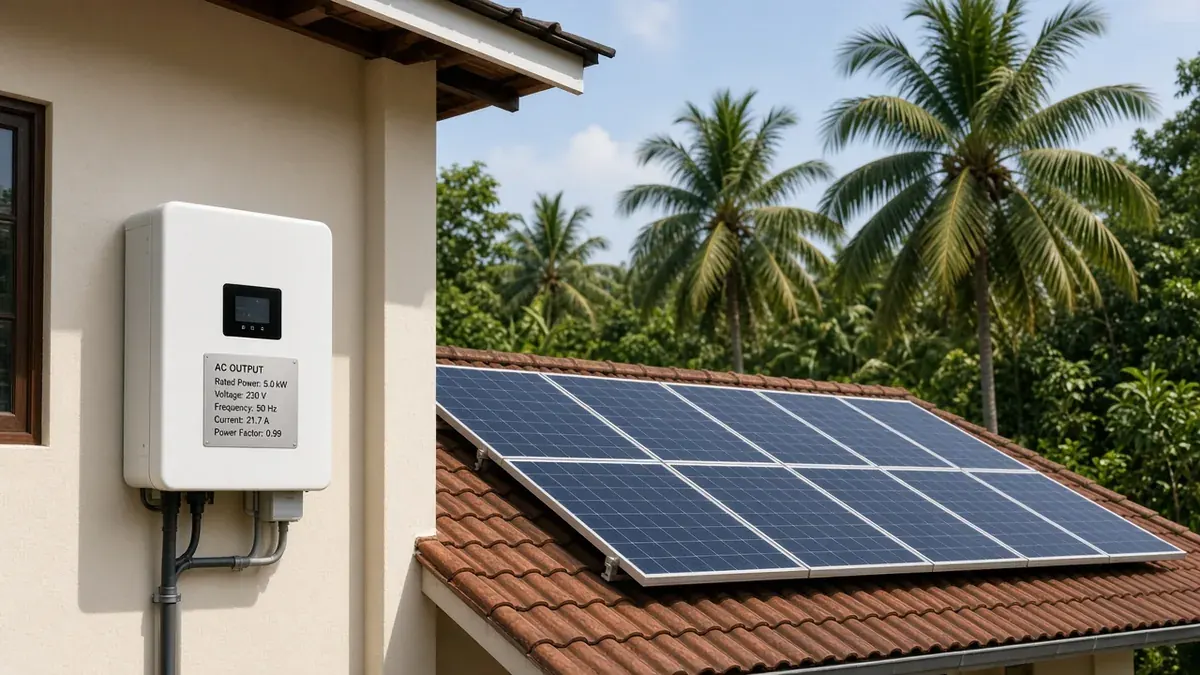
When KSEB asks for your solar plant capacity in Kerala, it means the AC rating of your inverter in kilowatts (kW). It does not mean the total wattage of your panels in kWp. This one detail decides how your plant is registered, whether it fits your connected load and which net metering band it falls into.
Panels can be sized a little higher than the inverter, but the inverter must never put out more AC power than its rating. This guide explains the rule in plain words, walks through a worked example and gives planning figures for how much a 3 kW or 5 kW plant generates in Kerala. It is based on the KSERC (Renewable Energy and Related Matters) Regulations, 2025.
Quick answer
Solar plant capacity in Kerala is the inverter's nominal AC output in kW (Regulation 3(73)).
Panels can total more kWp than the inverter kW if the design suits the site and the inverter never exceeds its AC rating (Regulation 16.6). The plant still cannot be larger than your connected load or contract demand (Regulation 6.6).
Key takeaways
- KSEB counts the inverter's AC kW as plant capacity, not the panel kWp (Regulation 3(73)).
- Panel kWp may be higher than inverter kW, as long as AC output never exceeds the inverter rating (Regulation 16.6).
- Plant capacity cannot exceed your connected load in kW, or your contract demand in kVA (Regulation 6.6).
- A single-phase inverter can connect at most 3 kW (Regulation 16.5).
- For planning, a 3 kW plant in Kerala commonly produces roughly 10 to 13 units a day, depending on shading, tilt and season.
What solar plant capacity in Kerala means for KSEB
Under Regulation 3(73), the plant capacity of a solar generation system is the nominal capacity on the AC side of the inverter, measured in kW. This is the KSEB plant capacity figure that goes into your application. Regulation 3(51) says the same for installed capacity of solar PV: it is the sum of the inverters' nameplate AC ratings.
Domestic net metering bands, such as 1 kW to 20 kW, are also read in inverter AC kilowatts, not as a total of panel stickers. Our guide to the 20 kW domestic net metering limit explains the top of that band. If a quote says "5 kW solar" without saying whether that means inverter AC or panel kWp, ask for both numbers in writing.
Inverter kW vs panel kWp: what is the difference?
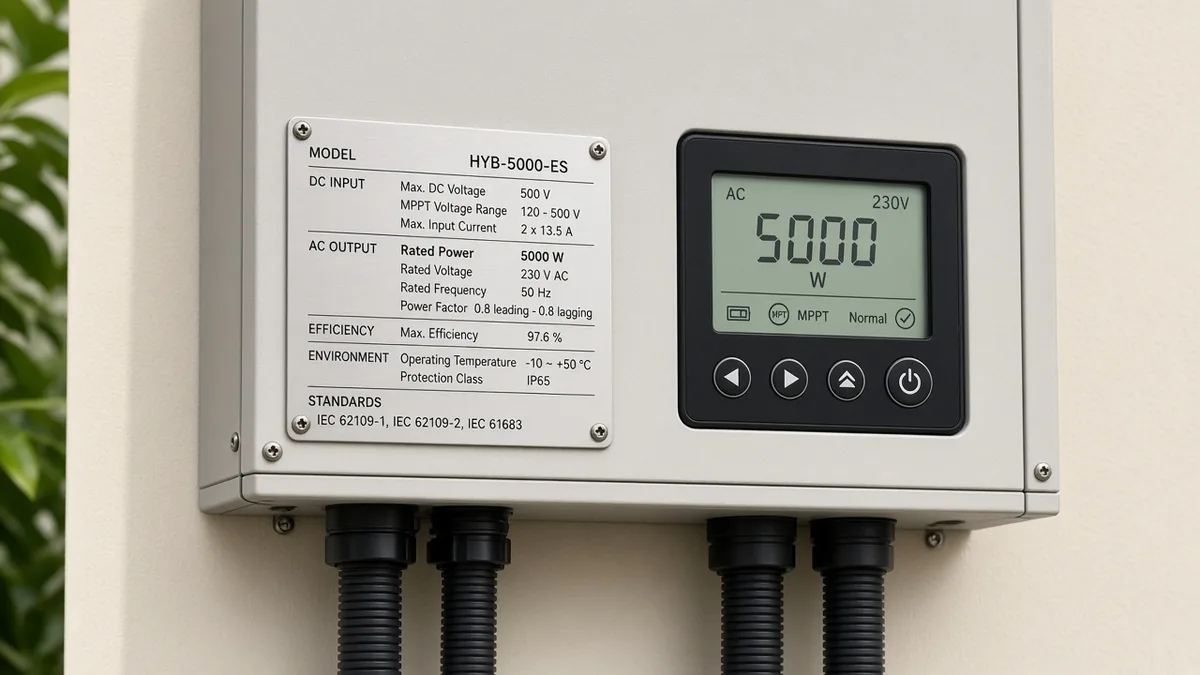
Every solar panel system has two ratings. Panels produce direct current (DC), rated in kWp. The inverter converts it to alternating current (AC) for your home and the grid, rated in kW. For KSEB, the inverter number counts.
| Term | What it measures | Where you find it | What it is used for |
|---|---|---|---|
| Panel kWp | Combined peak DC rating of all modules | Module datasheet x number of modules | DC design only (Regulation 16.6) |
| Inverter kW (AC) | Maximum AC output the inverter delivers | Inverter nameplate and datasheet | Plant capacity (Regulation 3(73)) |
| Installed capacity | Sum of inverter nameplate AC ratings | Inverter nameplates | Installed capacity of solar PV (Regulation 3(51)) |
| Connected load or contract demand | Your sanctioned load in kW, or contract demand in kVA | Your KSEB bill | Upper cap on plant capacity (Regulation 6.6) |
How solar panel size adds up to kWp
On a quotation, solar panel size usually refers to the wattage of each module. Multiply the module wattage by the number of modules and divide by 1,000 to get kWp. For example, ten modules of 550 W each make 5.5 kWp.
Module size and wattage vary by model, so read the datasheet your installer attaches.
Can panel kWp be higher than inverter kW?
Yes. Regulation 16.6 allows the DC capacity of the panels to be designed from site needs, feasibility, environment, inverter behaviour, capacity utilisation factor and similar factors. The hard condition is that the inverter's AC output must not exceed its rated capacity at any time of use.
The link between the two ratings is often called the DC to AC ratio. You get it by dividing panel kWp by inverter kW. A ratio above 1 means the panel field is larger than the inverter.
Worked example: 5.5 kWp of panels on a 5 kW inverter
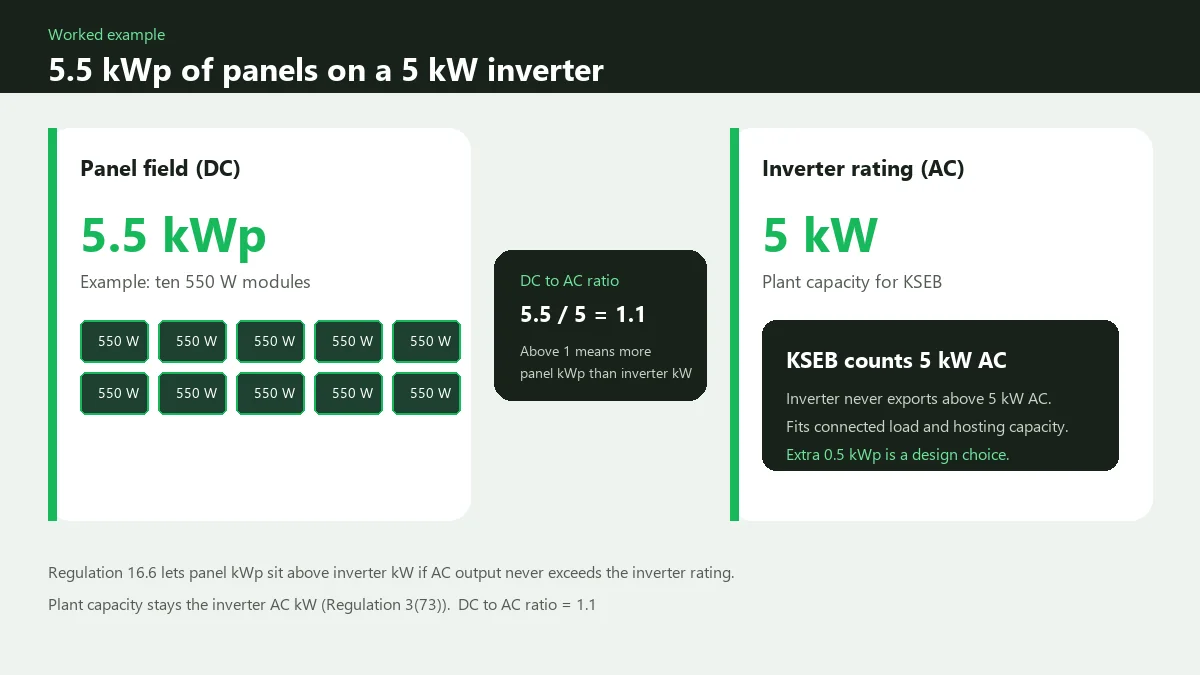
A home installs a 5 kW three-phase inverter with 5.5 kWp of panels, for example ten 550 W modules.
| Item | Value |
|---|---|
| Panel field (DC) | 5.5 kWp |
| Inverter rating (AC) | 5 kW |
| DC to AC ratio | 5.5 / 5 = 1.1 |
| Plant capacity for KSEB | 5 kW |
| Conditions | Inverter never exports above 5 kW AC; 5 kW fits within connected load and transformer hosting capacity |
So this home is a 5 kW plant for KSEB, as long as the conditions above hold. The extra 0.5 kWp is a design choice, not extra plant capacity.
What a higher DC to AC ratio does and does not do
A slightly larger panel field can help the inverter reach useful output earlier in the morning, later in the evening and on cloudy days, so it can add some units. On a bright midday the inverter simply holds its output at its rating, which installers call clipping.
It does not raise your plant capacity, net metering band or connected load limit. The right ratio depends on the inverter's DC input limits, roof direction and shading. If you want a noticeably larger home solar power system, the usual route is a larger inverter, within your connected load and the single-phase limit.
Connected load and phase limits still cap your plant
Connected load (Regulation 6.6)
Regulation 6.6 sets a separate ceiling. The maximum plant capacity you may install cannot exceed your connected load in kW if you are billed on connected load, or your contract demand in kVA if you are billed on demand. Adding panel kWp under Regulation 16.6 does not let the inverter AC rating jump past that limit.
Your local transformer also needs spare capacity, which we cover in our guide to KSEB solar feasibility and transformer hosting capacity.
Single-phase inverter limit (Regulation 16.5)
A single-phase inverter may connect at most 3 kW of plant capacity. Above 3 kW you need three-phase inverters. Because plant capacity is inverter AC kW, a large panel field behind a 3 kW single-phase inverter does not turn the plant into a 5 kW single-phase connection.
How much does a 3 kW or 5 kW solar plant generate in Kerala?
Solar plant capacity in Kerala tells KSEB how big your plant is, not how many units it will produce. Generation depends on shading, tilt, direction, cleaning and season, and output usually drops in the monsoon months.
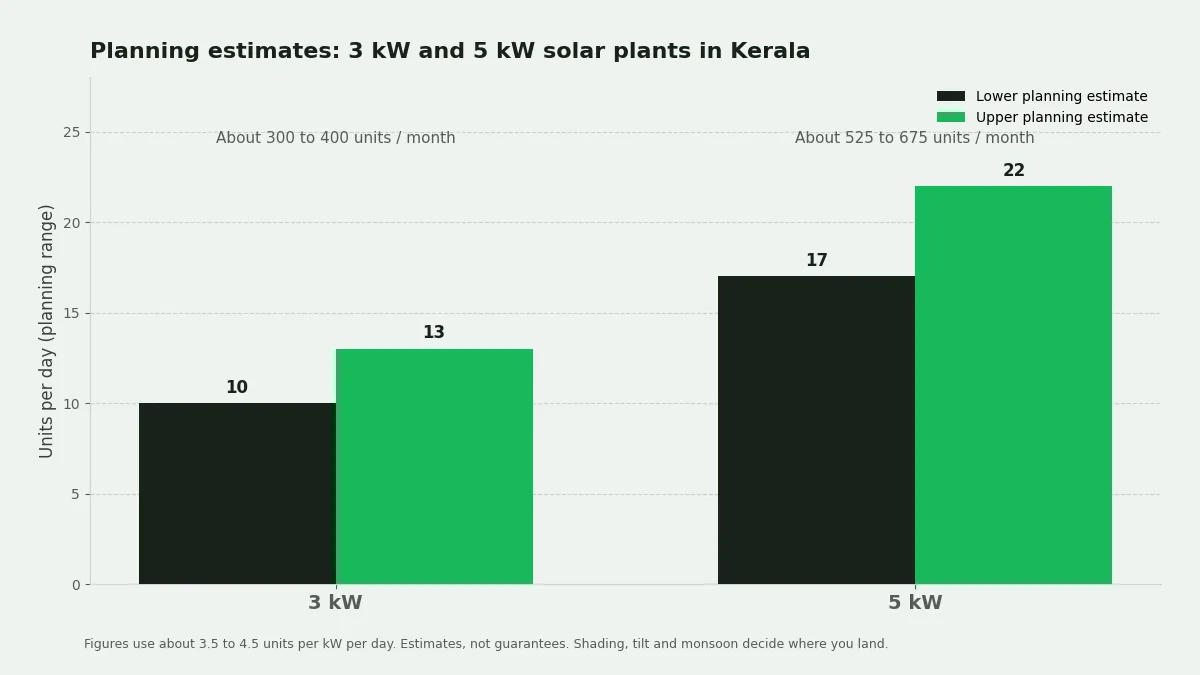
For planning, installers in Kerala commonly work with roughly 3.5 to 4.5 units per kW per day. The figures below use that range. They are estimates, not guarantees.
| Plant capacity (inverter kW) | Units per day (planning range) | Units per month (approx.) |
|---|---|---|
| 1 kW | 3.5 to 4.5 | 105 to 135 |
| 3 kW | about 10 to 13 | about 300 to 400 |
| 5 kW | about 17 to 22 | about 525 to 675 |
| 10 kW | about 35 to 45 | about 1,050 to 1,350 |
So for 3 kW solar panel unit generation, a fair planning figure is about 10 to 13 units a day, or roughly 300 to 400 units a month. A shaded roof or a long monsoon pushes it toward the lower end. Read how solar performs during the Kerala monsoon for more on seasonal dips. To decide between sizes for your bill, read 3 kW, 5 kW or 10 kW: which solar system size suits a Kerala home.
The 19% figure in Regulation 16.9 is for battery sizing only
KSERC's Regulation 16.9 uses a 19% capacity utilisation factor when working out battery storage. For 1 kW that is 1 kW x 24 hours x 0.19, or about 4.56 units per day. It is used only to size batteries, not as a generation guarantee for your roof. Our guide to hybrid inverter and battery rules explains when storage applies.
What changes when you replace panels or the inverter
For existing net-metered prosumers, Regulation 2.3(iii) lists capacity enhancement as one event that can change your metering status. The proviso is specific: replacing or adding solar panels, or replacing the inverter with a new inverter or hybrid inverter within plus or minus 10% of the original inverter capacity, is not treated as an enhancement of plant capacity.
| Change to an existing plant | Treated as capacity enhancement? |
|---|---|
| Replacing or adding solar panels | No |
| New inverter or hybrid inverter within plus or minus 10% of the original capacity | No |
| 3 kW inverter replaced with a 5 kW inverter | Yes. Plant capacity changes, so it needs a proper enhancement path |
How to read a solar panel system quotation in Kerala
Vendors sometimes advertise only the panel field, because a higher kWp number looks larger. For KSEB feasibility, registration and net metering, insist on the inverter AC kW rating that will go into the application. A clear quotation should list:
- Inverter model and its nominal AC kW (this is your plant capacity)
- Total panel kWp, module wattage and module count
- Your sanctioned connected load in kW, from the KSEB bill
- Single-phase or three-phase inverter, checked against Regulation 16.5
- Whether any battery storage is included, and why
If two quotes show the same inverter AC kW but very different panel kWp, ask how the larger DC field stays inside the inverter rating. A clear answer should mention inverter datasheet limits, not only a bigger brochure total. Keep the inverter datasheet and work completion papers with the AC rating visible, as section staff rely on them when plant capacity is questioned. To compare prices fairly, see our guide to solar panel installation cost in Kerala.
What FGE Solar recommends
Before we price any residential solar panel installation in Kerala, we match the plant to your bill and your connection. Our checklist:
| Check | Why it matters |
|---|---|
| Inverter AC kW written on the quote | This is your plant capacity for KSEB |
| Panel kWp and DC to AC ratio | Shows how much extra DC is planned and why |
| Connected load on your KSEB bill | Plant capacity cannot exceed it |
| Single-phase or three-phase supply | Decides whether you can go above 3 kW |
| Expected units per month | Should be a planning range, not a promise |
| Monthly bill and daytime usage | Decides whether 3 kW, 5 kW or more is worth paying for |
You can get a first estimate from our solar calculator for Kerala using your bill amount, then ask us to confirm it with a site visit.
Frequently asked questions
Is solar plant capacity in Kerala based on panels or the inverter?
The inverter. Regulation 3(73) defines plant capacity as the nominal AC kW on the inverter side. Panel kWp is a separate DC rating used for design.
Can I install more panel kWp than my inverter kW?
Yes, within design limits. Regulation 16.6 lets the DC panel capacity follow the site and the inverter, as long as the inverter's AC output never goes above its rated capacity at any time.
How many units does a 3 kW solar plant generate per day in Kerala?
As a planning estimate, roughly 10 to 13 units a day, or about 300 to 400 units a month. Shading, tilt and the monsoon decide where you land in that range.
Can my solar plant be larger than my connected load?
No. Regulation 6.6 caps plant capacity at your connected load in kW, or your contract demand in kVA if you are billed on demand.
Does a 5 kWp panel field on a 3 kW single-phase inverter make a 5 kW plant?
No. Plant capacity stays at the inverter's 3 kW AC rating under Regulations 3(73) and 16.5. The extra panel kWp is only a DC design choice under Regulation 16.6.
Does adding panels increase my sanctioned solar capacity?
Not by itself. For existing prosumers, replacing or adding panels is not treated as a capacity enhancement under Regulation 2.3(iii). Fitting a much larger inverter, outside plus or minus 10% of the original, is a different case.
Official sources and accuracy note
- 01KSERC (Renewable Energy and Related Matters) Regulations, 2025
Regulations 2.3(iii), 3(51), 3(73), 6.6, 16.5, 16.6 and 16.9 (erckerala.org) - 02KSEB consumer and rooftop solar application information
kseb.in and your electrical section office
This guide summarises official regulations as of 29 September 2026. Generation figures are planning estimates, not guarantees. Rules and limits can change, so please check the latest KSERC and KSEB documents before you pay, apply or file a complaint.
Not sure what plant capacity your quote really shows? Send us your latest KSEB bill and the quotation, and we will check the inverter kW, panel kWp and connected load before you commit.
Request a free system review from FGE Solar, a solar company in Kerala that handles the KSEB paperwork end to end.
Request a free system review
Send us your latest KSEB bill and the quotation, and we will check the inverter kW, panel kWp and connected load before you commit.