Hybrid Inverter Battery Rules in Kerala: Storage Needed by Plant Size
If you are planning a larger rooftop plant or replacing an old inverter, the hybrid inverter battery rules in Kerala decide whether a battery is compulsory and how big it must be. Under the KSERC (Renewable Energy and Related Matters) Regulations, 2025, a home plant above 10 kW needs a hybrid inverter with storage. From 1 April 2027, the same duty reaches new applications above 5 kW.
Below: what a hybrid inverter does, which size band you fall in, how the battery share is worked out and what an inverter swap means, with regulation numbers so you can check them.
Quick answer
Home plants above 10 kW and up to 15 kW need a hybrid inverter with at least 10% storage; above 15 kW up to 20 kW, at least 20%. From 1 April 2027, new applications above 5 kW up to 10 kW also need 10% storage. An inverter swap within ±10% of the old capacity is not an upgrade.
Key takeaways
- Up to 5 kW: no storage condition on any date (Regulation 6.3).
- Above 5 kW up to 10 kW: no storage today; 10% if you seek feasibility from 1 April 2027.
- Above 10 kW up to 15 kW: at least 10%. Above 15 kW up to 20 kW: at least 20%.
- The share is of energy generation potential at a 19% CUF (Regulation 16.9).
- An inverter swap within ±10% keeps your existing net metering (Regulation 2.3(iii)).
- The 2027 changes depend on the date you seek feasibility, not the switch-on date.
What a hybrid inverter for home use does
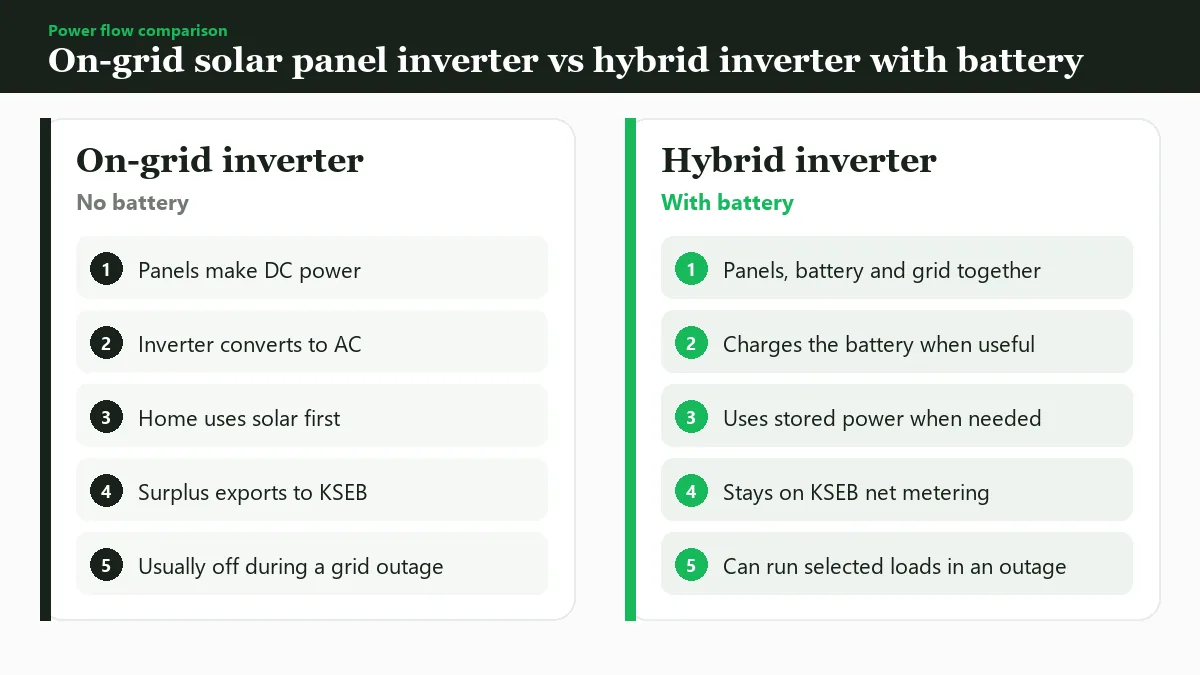
Solar panels produce DC power, while your home and the KSEB grid run on AC, so every plant needs an inverter. A hybrid inverter also manages a battery. It runs your panels, the battery and the grid together, deciding when to charge the battery, when to use it and when to export.
If you are weighing up an off-grid and on-grid solar system, a hybrid setup sits between the two.
It stays on KSEB net metering like an on-grid plant and stores energy like an off-grid one.
Depending on the wiring, it can also keep selected loads running during a power cut. See our hybrid solar system page for how FGE Solar designs them.
Hybrid inverter vs a normal on-grid solar panel inverter
A normal on-grid solar panel inverter has no battery. It powers your home first and exports the rest. As a safety feature, it usually switches off when the grid fails, so you get no solar power during a power cut.
| Feature | On-grid inverter | Hybrid inverter | Off-grid inverter |
|---|---|---|---|
| Connected to KSEB grid | Yes | Yes | No |
| Battery | None | Yes | Yes |
| Net metering with KSEB | Yes | Yes | No |
| Power during a grid outage | Usually no | Yes, from the battery, for the loads it is wired to | Yes, from the battery |
| Meets the storage rule for larger home plants | No | Yes, with the required battery | Not applicable |
Where no battery is required, an on-grid solar system is usually the simplest choice. Our guide to on-grid vs off-grid vs hybrid solar compares all three.
Who the hybrid inverter battery rules in Kerala apply to
For homes, net metering is open from 1 kW to 20 kW under Regulation 6.1. Regulation 6.3 adds battery conditions to the larger sizes in that window. Read more about the 20 kW limit for home net metering.
Regulation 6.6 adds one more limit: the plant cannot be bigger than your connected load in kW, or your contract demand in kVA if you are billed on demand. Industrial and apartment common-area connections have separate storage steps above 25 kW (Regulations 6.4 and 6.5). A flat's own connection follows the home rules here.
Solar battery storage in Kerala by plant size
If your home solar panel system falls in one of the storage bands below, it must use a hybrid inverter with at least that share of storage.
| Home plant size | Hybrid inverter and minimum storage | Applies to |
|---|---|---|
| Up to 5 kW | No storage condition | All dates |
| Above 5 kW up to 10 kW | No storage condition | Feasibility sought before 1 April 2027 |
| Above 5 kW up to 10 kW | 10% of energy generation potential | Feasibility sought from 1 April 2027 |
| Above 10 kW up to 15 kW | 10% of energy generation potential | New plant or upgrade, any date |
| Above 15 kW up to 20 kW | 20% of energy generation potential | New plant or upgrade, any date |
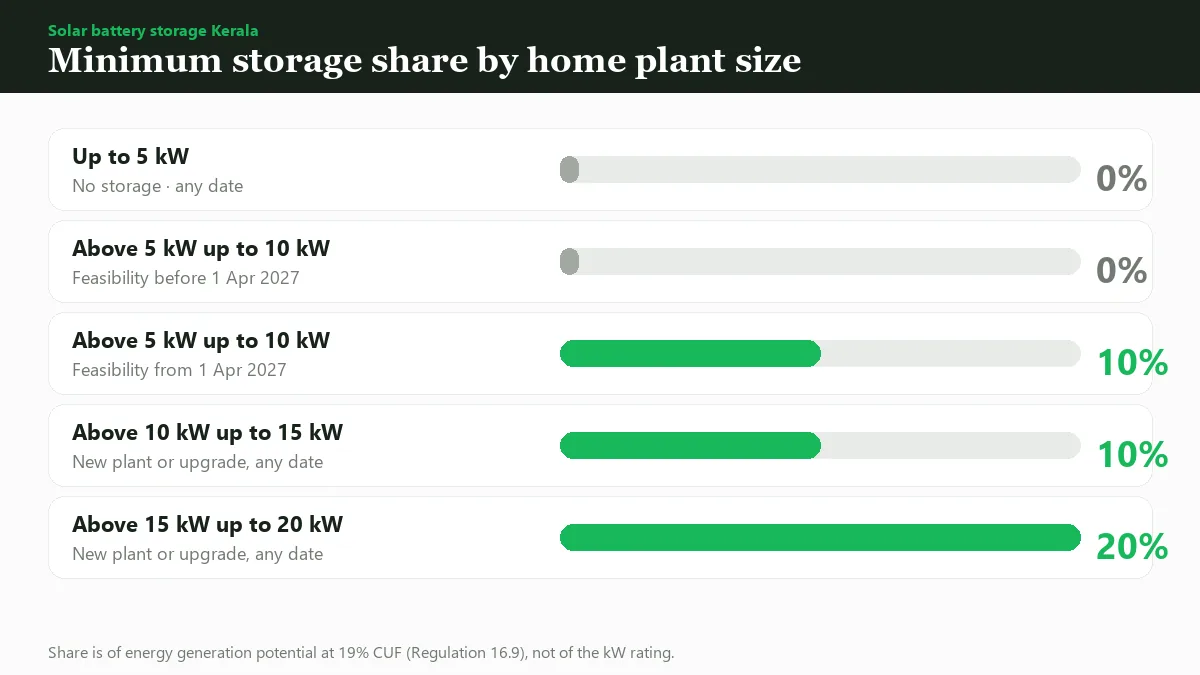
Each upper limit includes the figure itself. A 10 kW plant has no storage condition today, a 15 kW plant needs 10%, and a 20 kW plant needs 20%. The percentages are minimums: the regulation says the plant shall install hybrid inverters with at least that storage, so a bigger battery is allowed.
Is there a 10 kW solar battery requirement?
Not today. A 10 kW plant sits in the band above 5 kW up to 10 kW, which has no storage condition if you seek feasibility before 1 April 2027. From that date, new plants in this band need at least 10% storage, so the timing of your application can decide whether a battery is needed at all.
How the storage share is worked out
The percentage is taken from the plant's energy generation potential, not from its kW rating.
Regulation 16.9 says that potential is worked out using a capacity utilisation factor (CUF) of 19% when estimating storage.
A CUF of 19% means the plant is assumed to deliver 19% of the energy it would make if it ran at full rated power round the clock.
Worked example: battery sizing for a 12 kW plant
This is an illustration only. The exact method follows Regulation 16.9 and how KSEB applies it, so confirm the final figure before you buy.
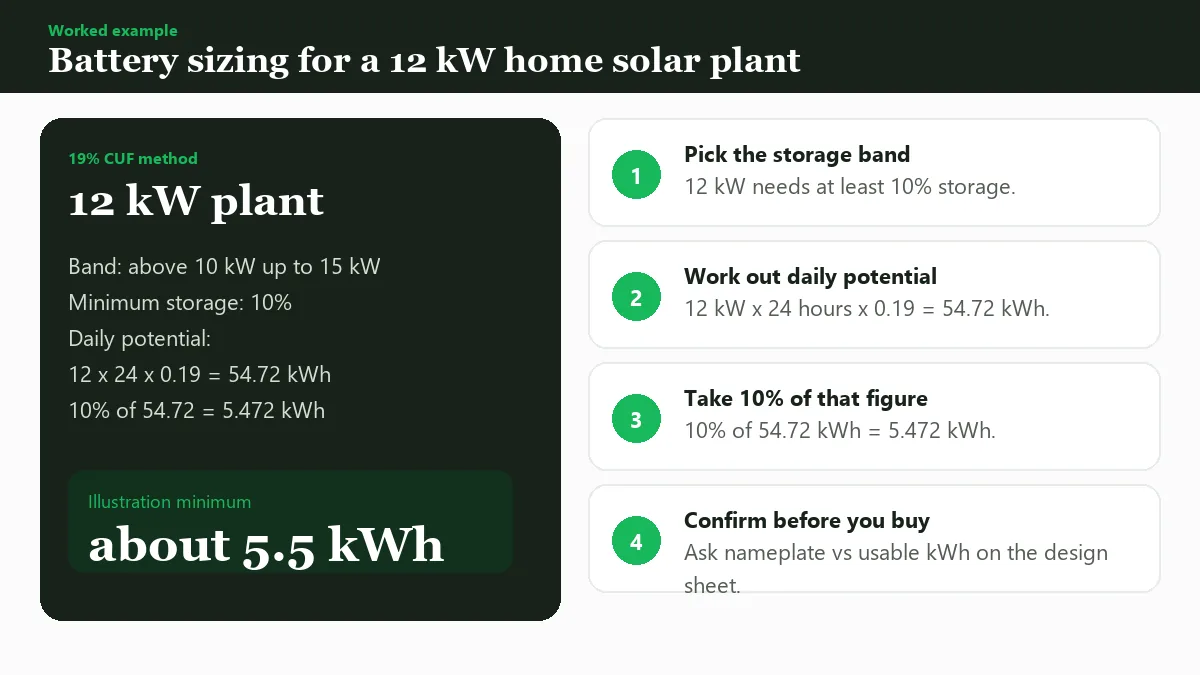
- A 12 kW plant falls in the band above 10 kW up to 15 kW, so it needs at least 10% storage.
- Energy generation potential for a day at 19% CUF: 12 kW x 24 hours x 0.19 = 54.72 kWh.
- 10% of 54.72 kWh = 5.472 kWh.
- So, on this illustration, the minimum storage is about 5.5 kWh.
On the same basis, a 20 kW plant at 20% works out to 20 x 24 x 0.19 = 91.2 kWh a day, and about 18.2 kWh of storage. Batteries have a nameplate and a usable capacity, which can differ, so ask which figure the design sheet uses.
Plant size is read from the inverter, not the panels
Regulation 3(73) defines the plant capacity of a solar system as the nominal AC capacity of its inverter in kW. In other words, plant capacity is the inverter's AC rating.
Regulation 16.6 lets the panel (DC) capacity in kWp be designed around your roof and the inverter, provided the inverter's AC output never exceeds its rated capacity. So the panel wattage on the roof may be higher than the inverter's kW rating, and the storage band still follows the inverter.
Replacing an old inverter with a hybrid inverter
If you already had net metering when the regulations began, Regulation 2.3 keeps you on it until one of three things happens: you choose another metering system, the plant reaches the end of its useful life counted from the net-metering connection date, or you enhance the plant's capacity. Regulation 1.3 also treats people who had feasibility or registration before notification, and finish installation on time, as existing prosumers.
Regulation 2.3(iii) spells out what is not an enhancement: replacing or adding solar panels, or replacing the existing inverter with a new inverter or hybrid inverter whose capacity is within ±10% of the original inverter capacity.
For example, if your old inverter is 5 kW, a new hybrid inverter rated anywhere from 4.5 kW to 5.5 kW keeps your existing prosumer status. A replacement outside that range does not get this protection.
Grid support charges and the 1 April 2027 change
Grid support charges are billed on the power you draw from the grid in non-solar hours, but only up to the banked solar units set off against it. Regulation 28.7 gives an example: if you draw 400 units in non-solar hours and have 300 banked units after normalisation, the charge applies to 300 units.
KSERC may later fix the charges in a tariff order. Until then, the interim rules below apply. Our guide to grid support charges in Kerala covers them in detail.
| Home plant | Grid support charge (interim) |
|---|---|
| Existing prosumer, up to and including 10 kW | Exempt |
| New plant up to and including 5 kW | Exempt |
| New plant above 5 kW up to 10 kW, feasibility before 1 April 2027 | Exempt |
| New plant above 5 kW up to 10 kW, feasibility from 1 April 2027 | 50 paise per unit for the first 300 units a month, ₹1 per unit after that |
| Any home plant above 10 kW | 50 paise per unit for the first 300 units a month, ₹1 per unit after that |
Both 2027 changes depend on the date you seek feasibility from KSEB, not the date the plant is switched on. Feasibility depends on your local transformer, so check transformer hosting capacity early if you want to apply before that date.
Single-phase or three-phase hybrid inverter
Regulation 16.5 allows at most 3 kW through a single-phase inverter. Above 3 kW, three-phase inverters are required.
Existing prosumers, including those with feasibility up to the notification date, can keep their existing or proposed inverter. Where no three-phase network is available when you seek feasibility, a single-phase inverter of up to 5 kW is allowed for applications made until 31 March 2027.
What FGE Solar checks before you sign a hybrid inverter quote
Before recommending a hybrid or on-grid solar energy system for home use, the FGE Solar team checks:
| Check | Why it matters (Regulation) |
|---|---|
| Plant size against the connected load on your KSEB bill | The plant cannot exceed it (6.6) |
| Storage kWh on the design sheet, on the 19% CUF basis | Needed in a storage band (6.3, 16.9) |
| Inverter phase | Three-phase above 3 kW, unless the exception applies (16.5) |
| Old and new inverter ratings side by side | Shows a replacement is within ±10% (2.3(iii)) |
| Expected feasibility date, for plants above 5 kW | 1 April 2027 changes storage and grid support charges (6.3, 28.7) |
Not sure you need a larger plant at all? Try our KSEB bill calculator first.
Frequently asked questions
Do I need a battery for a 5 kW home solar system in Kerala?
No. Today the home storage rule starts above 10 kW, and from 1 April 2027 it reaches new applications above 5 kW. A plant of exactly 5 kW sits outside every storage band in Regulation 6.3.
Is a battery required for a 10 kW solar plant in Kerala?
Not if you seek feasibility before 1 April 2027. A 10 kW plant has no storage condition today. A new 10 kW plant that seeks feasibility on or after 1 April 2027 needs a hybrid inverter with at least 10% storage.
How much battery storage does a 12 kW home solar plant need?
At least 10% of its energy generation potential, reckoned at a 19% CUF, through a hybrid inverter. As an illustration, 12 x 24 x 0.19 gives 54.72 kWh a day, and 10% of that is about 5.5 kWh. Confirm the exact figure with your installer and KSEB.
Will replacing my inverter with a hybrid inverter end my net metering?
Not if the new inverter's capacity stays within ±10% of your old inverter. Regulation 2.3(iii) says such a replacement is not an enhancement of capacity, so your existing prosumer status continues.
Will my 8 kW solar plant pay grid support charges?
Not if it is an existing plant or seeks feasibility before 1 April 2027, because home plants up to 10 kW are exempt. From that date, a new plant above 5 kW pays 50 paise a unit for the first 300 units each month and ₹1 a unit after that.
When did the hybrid inverter battery rules in Kerala start?
The KSERC Renewable Energy and Related Matters Regulations, 2025 took effect on publication in the Kerala Gazette on 6 November 2025. Chapter III billing and settlement began on 1 January 2026.
Official sources and accuracy note
- 01KSERC (Renewable Energy and Related Matters) Regulations, 2025
Regulations 1.3, 2.3, 3(73), 6.1, 6.3, 6.4, 6.5, 6.6, 16.5, 16.6, 16.9 and 28.7 (erckerala.org) - 02KSEB notices on feasibility, net metering and tariffs
kseb.in and your electrical section office
This guide summarises official regulations as of 29 September 2026. Rules and charges can change. Please check the latest KSERC and KSEB documents before you pay, apply or file a complaint.
Planning a plant above 5 kW or replacing an old inverter? Send us your KSEB bill and inverter details, and we will confirm your storage band and battery size. Request a free hybrid inverter quote review from FGE Solar, a solar company in Kerala that handles the KSEB paperwork end to end.
Request a free hybrid inverter quote review
Send us your KSEB bill and inverter details, and we will confirm your storage band and battery size.