KSEB Solar Feasibility in Kerala: Transformer Hosting Capacity Explained
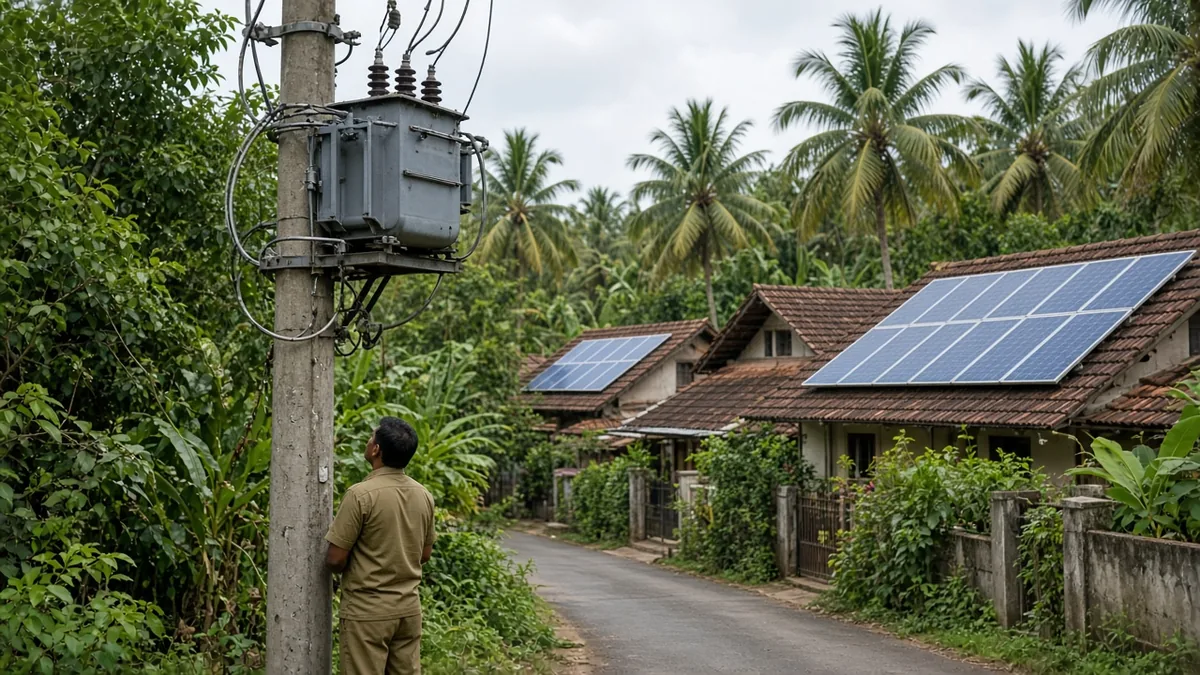
Before any rooftop solar plant can connect to the grid in Kerala, KSEB has to confirm it is technically feasible. The KSEB solar feasibility check has little to do with your roof. It depends mostly on the distribution transformer that serves your street, and how much solar is already connected to it. If that transformer is nearly full, your application can be refused even if your roof and your bill are perfect for solar.
This guide explains the hosting capacity rules in plain words, how long KSEB has to decide, and what to do if your feasibility is refused. It is based on the KSERC (Renewable Energy and Related Matters) Regulations, 2025. For the wider picture, see our guide to rooftop solar rules in Kerala.
Quick answer
KSEB solar feasibility is approved only if your local transformer has hosting capacity left. All renewable plants on one transformer can use up to 90% of its rated capacity, and each phase up to 30%. KSEB must decide within 15 days of a complete online application; if it does not, feasibility is treated as granted.
Key takeaways
- Feasibility is about your transformer and your connection, not your roof size.
- Total renewables on a transformer: up to 90% of its capacity (Regulation 16.2).
- Each phase: up to 30% of transformer capacity (Regulation 16.2).
- Plants up to 5 kW can get limited over-hosting (up to 20% more) with the right inverter setup (Regulation 16.3).
- KSEB has 15 days to decide. A missed deadline on a complete application means deemed approval.
- If you are refused for lack of capacity, KSEB must tell you within six months if capacity opens up.
What is KSEB solar feasibility?
When you apply for a grid-connected rooftop solar plant, KSEB runs a technical feasibility study.
It checks whether the local network can safely take the extra solar power you will export during the day. Only after feasibility is approved can your installer complete the work and move to net metering.
The study looks at three things: spare hosting capacity on your transformer and phase, your sanctioned connected load, and whether your inverter type matches your supply (single-phase or three-phase). Most refusals in Kerala come from the first one.
What solar hosting capacity means in Kerala
Hosting capacity is the amount of rooftop solar and other renewable generation a distribution transformer can accept before voltage and safety problems start. Every transformer has a fixed rating. As more homes on the same transformer add solar, the spare capacity shrinks.
This is why two neighbours can get different answers. One applied when capacity was available. The other applied after the transformer had filled up. In neighbourhoods where many homes have already added rooftop solar, this is now a common reason for delay.
The 90% transformer limit and 30% phase limit
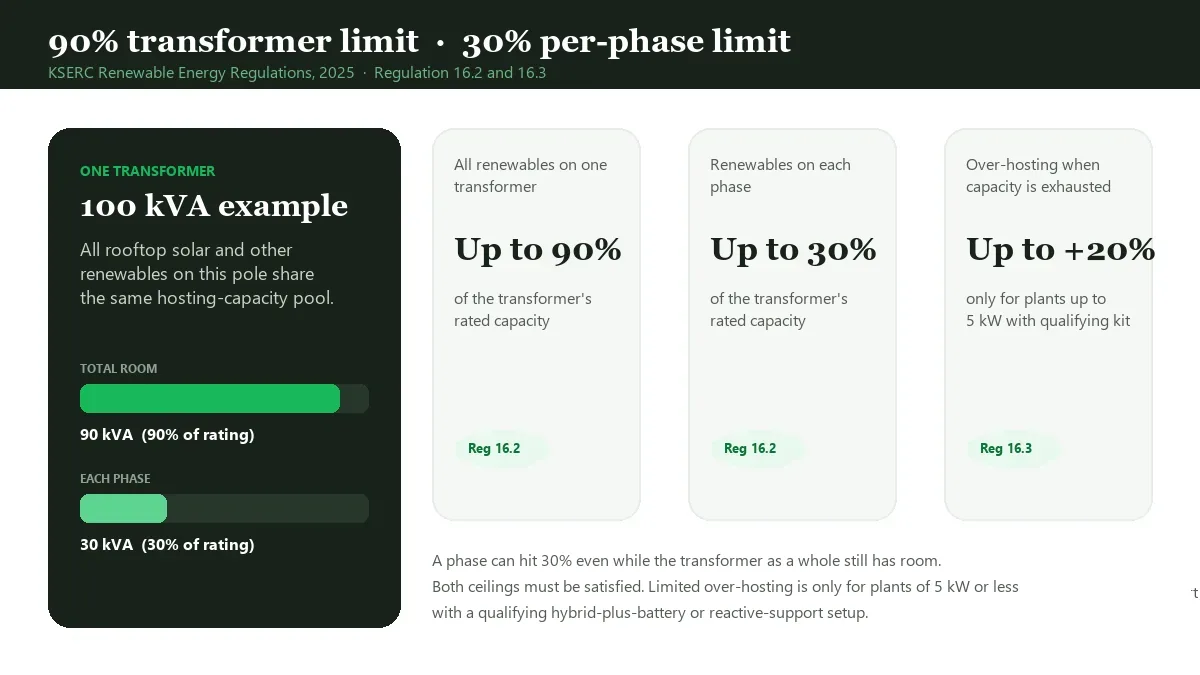
Regulation 16.2 sets two ceilings on transformer capacity for rooftop solar and other distributed renewables. Both have to be satisfied.
| Limit | What it means | Regulation |
|---|---|---|
| All renewables on one transformer | Up to 90% of the transformer's rated capacity | 16.2 |
| Renewables on each phase | Up to 30% of the transformer's rated capacity | 16.2 |
| Over-hosting when capacity is exhausted | Up to 20% above the limit, only for plants up to 5 kW with qualifying equipment | 16.3 |
A simple example
Take a 100 kVA transformer. Renewable plants on it can add up to 90% of that rating in total, and no single phase can carry more than 30% of it. If most homes on your street are on the same phase and have already added solar, that phase can hit its 30% share even while the transformer as a whole still has room. KSEB can then refuse a new plant on that phase.
Limited over-hosting for plants up to 5 kW
When hosting capacity is used up, Regulation 16.3 allows up to 20% over-hosting for plants of 5 kW or less, but only with one of these setups:
- A hybrid inverter with dynamic reactive power support, plus battery storage of at least 30% of the plant's energy generation potential, or
- An inverter with reactive power support, plus a smart meter that lets the utility curtail output when the grid is constrained.
Both options add cost, so compare them against waiting for capacity. Our guide to hybrid inverter and battery rules explains how storage is sized.
How long KSEB takes to decide feasibility
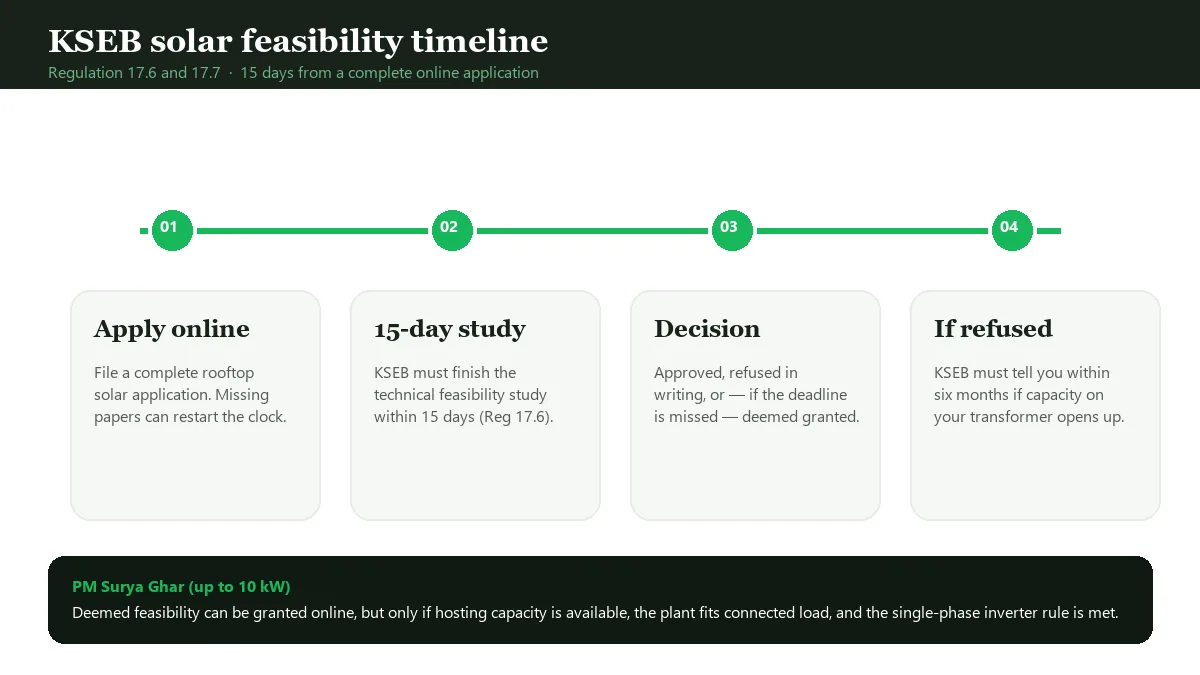
Under Regulation 17.6, KSEB has 15 days from the date of a complete online application to finish the technical feasibility study. If it misses the deadline on a complete application, feasibility is deemed granted under Regulation 17.7.
The word "complete" matters. Missing documents or a wrong connected load figure can restart the clock, so keep your paperwork in order before applying.
Deemed feasibility under PM Surya Ghar (up to 10 kW)
Homes applying through the MNRE rooftop solar scheme, PM Surya Ghar Muft Bijli Yojana, can get deemed feasibility through online verification for plants up to 10 kW. This is faster, but it is not a free pass. It still needs:
- Available hosting capacity on your transformer and phase
- A plant size within your sanctioned connected load
- Compliance with the single-phase inverter rule in Regulation 16.5
Read more on the PM Surya Ghar subsidy in Kerala.
Two more checks that can block your KSEB solar application
Connected load
Your plant capacity cannot be more than your sanctioned connected load in kW, or your contract demand in kVA if you are billed on demand. Remember that plant capacity is the inverter's AC rating, not the total of the panel wattage. If you want a larger plant than your connected load allows, apply to KSEB for a load enhancement first.
Single-phase inverter limit
A single-phase inverter can connect at most 3 kW. Anything larger needs a three-phase inverter.
Existing prosumers keep their earlier arrangement. Until 31 March 2027, homes in areas that do not have a three-phase network can use a single-phase inverter of up to 5 kW.
How to check your transformer's spare capacity
KSEB has to publish hosting capacity for each distribution transformer by the 10th of every month. The figures are displayed at the electrical section office and on the KSEB website.
KSEB has an online page for this: KSEB Web Self Service, renewable energy systems connected in your transformer. Enter your 13-digit consumer number and press Check Capacity. For your transformer it shows 90% of its capacity in kW, the feasibility already issued in kW, the capacity already grid connected in kW and the balance available in kW. You can also pick your section to see every transformer in it. If the balance available is smaller than the plant you plan, talk to your installer before paying an advance.
- Find your transformer name or number. Your section office can tell you from your consumer number.
- Check the latest monthly hosting capacity list for that transformer.
- Note the spare capacity and, if shown, the phase-wise figures.
- Compare it with the plant size you plan. If spare capacity is lower, talk to your installer before paying an advance.
KSEB feasibility rejected? What to do next
- Ask for the reason in writing. Under Regulation 17.7, KSEB must explain a refusal on technical grounds. Keep a copy.
- Check whether the issue is capacity, connected load or phase. Each has a different fix.
- If it is connected load, apply for a load enhancement and then reapply.
- If it is the single-phase limit, ask about moving to three-phase supply, or the 5 kW single-phase exception if your area has no three-phase network (until 31 March 2027).
- If the transformer is full and your plant is 5 kW or less, ask your installer to price the over-hosting options under Regulation 16.3.
- Otherwise, wait for capacity. KSEB must tell you within six months if capacity becomes available on your transformer.
Keep your solar documents checklist ready so you can reapply quickly when capacity opens.
What we check before a solar panel installation in Kerala
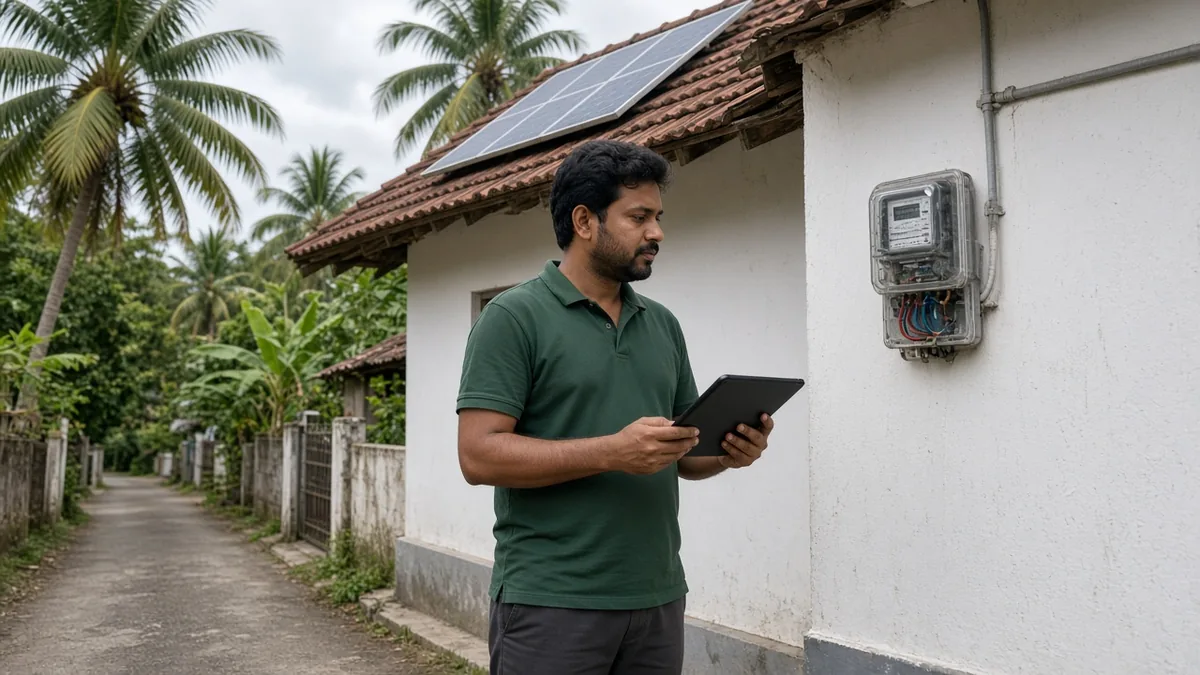
A good installer checks feasibility risks before taking your money. Before any residential solar panel installation in Kerala, the FGE Solar team checks:
| Check | Why it matters |
|---|---|
| Transformer and phase hosting capacity | The main reason for KSEB refusals |
| Sanctioned connected load on your bill | Plant size cannot exceed it |
| Single-phase or three-phase supply | Decides the maximum inverter size |
| Subsidy route (PM Surya Ghar or not) | Affects deemed feasibility and panel choice |
| Net metering timeline | Your savings start only after the KSEB net metering connection is live |
These checks take a few minutes with your latest KSEB bill and avoid weeks of waiting for a solar installation in Kerala that was never going to be approved.
Frequently asked questions
Why was my KSEB solar feasibility rejected?
The most common technical reason is hosting capacity. Renewable plants on your local transformer may already be close to the 90% limit, or your phase may be near its 30% share.
KSEB must give the reason in writing, so ask for it and keep a copy.
What is the 90% transformer rule for rooftop solar in Kerala?
Under Regulation 16.2, all renewable plants on one distribution transformer together cannot exceed 90% of its rated capacity, and each phase can carry at most 30% of that capacity.
How long does KSEB take to decide solar feasibility?
KSEB has 15 days from a complete online application to finish the technical feasibility study. If it misses that deadline on a complete application, feasibility is treated as granted.
Does PM Surya Ghar skip the hosting capacity check?
No. Plants up to 10 kW can get deemed feasibility online, but only if hosting capacity is available, the plant fits your connected load and the single-phase inverter rule is met.
Can I still install rooftop solar if my transformer is full?
Possibly. Plants up to 5 kW can use limited over-hosting of up to 20% above the limit if they use a qualifying hybrid inverter with battery, or a reactive-support inverter with a smart meter.
Otherwise KSEB must tell you within six months if capacity opens up.
Can I install a 5 kW solar plant on a single-phase connection?
Normally a single-phase inverter is limited to 3 kW. Until 31 March 2027, homes in areas without a three-phase network can use a single-phase inverter up to 5 kW.
Already approved but still waiting for the meter? Read about net meter delays and what you can do meanwhile.
Official sources and accuracy note
-
01
KSERC (Renewable Energy and Related Matters) Regulations, 2025
Regulations 6.6, 16.2, 16.3, 16.5, 17.6 and 17.7 -
02
KSEB monthly transformer hosting capacity publications
kseb.in and your electrical section office -
03
PM Surya Ghar Muft Bijli Yojana national portal
pmsuryaghar.gov.in
Accuracy note: This guide summarises official regulations as of 29 September 2026. Rules and limits can change. Please check the latest KSERC and KSEB documents before you pay, apply or file a complaint.
Not sure if your transformer has room for solar?
Send us your latest KSEB bill and we will check your KSEB solar feasibility risks, connected load and phase before you commit. Request a free feasibility review from FGE Solar, a solar company in Kerala that handles the KSEB paperwork end to end.