Home Energy Audit with Your Meter: Find What Uses Most
Your KSEB bill shows one total. It does not say whether the geyser, the fridge or the living-room lights pushed you into a higher slab. A home energy audit is how you find out. This guide uses Energy Management Centre Kerala's own worksheet method and its Home Energy Assessment programme so you can check appliances with your meter, rank what uses most units, and know when to call a trained assessor.
Quick answer: List each appliance's watts and daily hours, turn watt-hours into units with EMC's divide-by-thousand step, and compare the monthly planning total with your bill. Read the meter display without opening the box, leave the fridge on, and hire an EMC-empanelled assessor when you want a formal report.
Key points before you start a household energy check
- A unit on your KSEB bill is one kilowatt-hour. Write down the meter reading, then work out what each appliance adds.
- EMC Kerala's worksheet multiplies watts by hours, then divides by one thousand to get units.
- Walk room by room. List every light, fan, fridge, AC, pump, heater, TV and charger you actually use.
- Wattages on nameplates vary by brand and model. Treat printed examples as planning figures, not fixed figures.
- Never open the meter box or break a seal. Read only the display you can see.
- If you want a formal report, EMC trains and lists Home Energy Assessors for Kerala homes.
What a home energy audit covers in Kerala
In Kerala, the Energy Management Centre (EMC) runs a Home Energy Assessment programme. EMC says the domestic sector uses more than 49% of the state's electrical energy. It defines a household energy check as a study of how the equipment and appliances in a house use energy, followed by a technical report with steps for efficiency and conservation. EMC is also the State Designated Agency that co-ordinates the Energy Conservation Act, 2001. That formal study is what a trained assessor delivers; this page shows the do-it-yourself checks you can run first.
- A formal assessment is done by an EMC-empanelled Home Energy Assessor who has finished EMC's 12-hour certificate course.
- EMC publishes the list of assessors on its website and on its Home Energy Assessment pages.
- Assessors can also advise when a house is still being designed, not only after you move in.
- Their syllabus covers lighting, fans and air conditioners, refrigerators, pumps, geysers and cooking appliances, other kitchen and electronic loads, report writing, electrical safety and earth leakage, inverters and screens, and domestic renewable-energy options.
How to check electricity use with your meter and a simple worksheet
EMC's domestic worksheet uses one clear method. For each appliance, multiply its power in watts by how many you have and by the hours you use it in a day. That product is watt-hours. Divide the house total by 1,000 to get daily units. Multiply by about 30 for a monthly planning figure. EMC's own sample house adds up to 7,117 watt-hours in a day, which is about 7.1 units a day and about 213 units in a 30-day month. The same PDF reminds you that nameplate watts are estimates, that brands differ, and that figures are usually for 230 V. For what a unit means on the bill itself, see what a unit on your KSEB bill really means.
Use these EMC planning figures only to fill your own sheet. Read the watts on your nameplate when you can.
| Appliance (EMC example) | Example watts | Example daily use in the sheet | What to do |
|---|---|---|---|
| Incandescent bulb | 40, 60 or 100 W | About 5 hours in the sheet examples | Prefer efficient lamps; switch off when you leave |
| Ceiling fan | 50 to 110 W | About 10 hours in the sheet examples | Note speed and regulator type |
| Television | About 90 W | About 5 hours in the sheet examples | Check standby habits separately |
| Refrigerator | About 100 W in the sheet example | Runs through the day | Do not switch off for a meter test |
| Electric iron | 750 or 1,000 W | Short daily use in the sheet | Time it and write the minutes |
| Water heater | About 3,000 W | Short daily use in the sheet | Note minutes and setpoint |
| Water pump | About 750 W | Short daily use in the sheet | Note how long the tank takes to fill |
A safe meter walk for one quiet hour:
- Write down the date, time and the full meter reading you can see without opening the box.
- Switch off what you can at the sockets and boards, but leave the fridge, home inverter and medical equipment on.
- Wait, then write the reading again. The difference is a rough picture of what still runs.
- Turn one heavy appliance on alone for a timed spell, then read again, to see how fast the digits move.
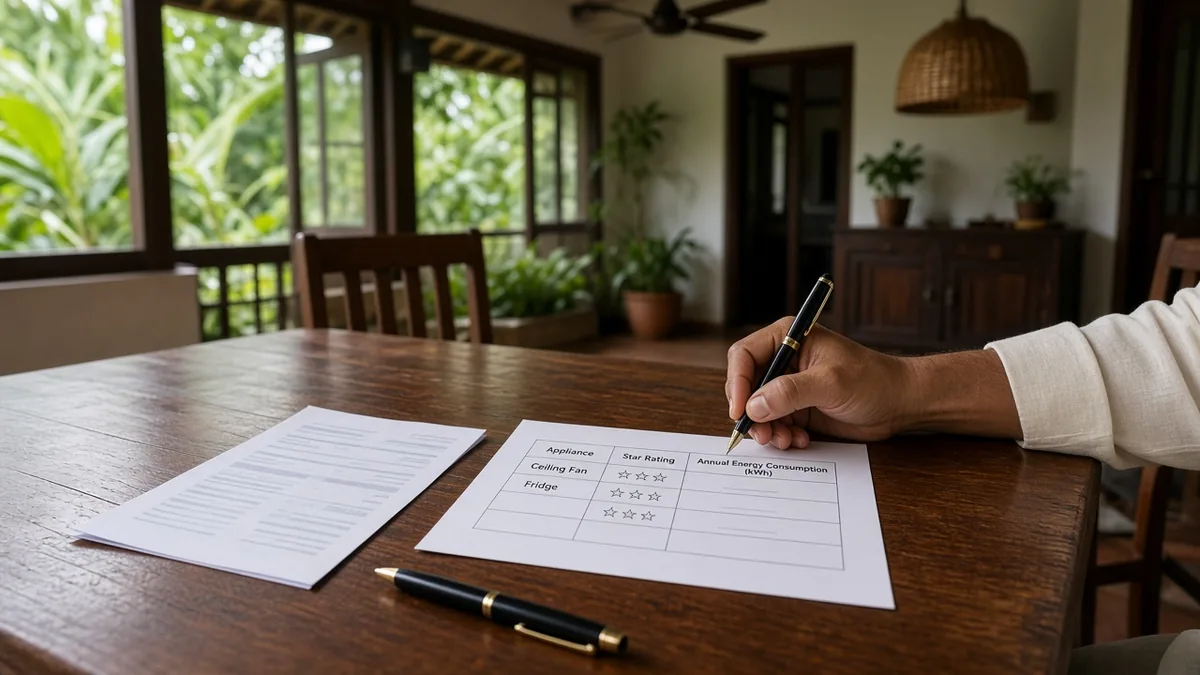
- Put each room on a paper sheet: appliance, watts from the label, how many, hours a day.
- Add the watt-hours, divide by one thousand, and compare the monthly planning total with your last bill.
What usually uses the most units in a Kerala home
EMC's cooling tip sheet lists the big indoor heat sources that also drive electricity use: water heaters, conventional lights, televisions, irons, computers, and cooking equipment. Its lighting tip sheet adds that lighting is often about 5 to 10 percent of home energy use, and that one unit is enough to run a 100 W bulb for 10 hours. In a Kerala house the fridge runs all day, the AC or cooler runs in the hot months, and the pump and geyser come on in short, heavy bursts. Rank your own sheet by monthly units, not by how often you notice the appliance.
- On a storage water heater, EMC's tip sheet says to turn the temperature down to 48°C and to insulate the tank and hot pipes where you can.
- With ceiling fans on, it suggests keeping the AC thermostat at 25°C or higher.
- Night ventilation helps when the incoming air is about 25°C or cooler.
- Choose air conditioners that carry a BEE star label, and clean the filter every month in the cooling season.
- Use daylight and task lighting first; switch room lights off when you leave.
For fridge habits already covered on this site, see refrigerator habits that cut units.
For hot-season cooling without leaning on the AC alone, see ways to keep a Kerala house cooler with less AC.
For wash-day timing and the label, see washing-machine label and load tips.
When you replace a machine, read how to read a BEE star label before you buy.
Fan regulators, standby loads and daytime solar hours
EMC measured a 1,400 mm ceiling fan with both regulator types at the same speeds. The table shows the watts it recorded. Use it to understand why the regulator type matters on your worksheet; do not treat the sheet's old bill example as your saving.
| Regulator step (matched speed) | Conventional regulator power (W) | Electronic regulator power (W) |
|---|---|---|
| Step 1 (176 rpm) | 50 | 28.4 |
| Step 2 (206 rpm) | 54 | 37.5 |
| Step 3 (233 rpm) | 60.5 | 47.5 |
| Step 4 (258 rpm) | 65.3 | 57.3 |
| Step 5 (283 rpm, 230 V) | 73.5 | 73.5 |
After dark, many screens and chargers keep drawing a trickle even when they look off. Map those on your audit sheet as always-on or standby loads, then follow what stays on when you think it is off. Leave the fridge and the home inverter alone.
If your home has rooftop solar, put a time column on the worksheet. Under KSERC's Renewable Energy Regulations, 2025, solar hours run from 8 am to 6 pm where your meter is programmed for those bands (Regulation 3(91)). Heavy daytime loads then meet the plant first. For how to shift washing, pumping and ironing into that window, see the best time to run appliances with solar.
When to call an EMC assessor or a licensed electrician
When your own sheet is not enough, hire an EMC-empanelled Home Energy Assessor from the published list. The prospectus fee of ₹3,500 plus GST (₹4,130 in total) is the charge for the assessor's training course, not a fixed price for auditing your house. Ask the assessor for a written quote. EMC's office is at Sreekaryam, Thiruvananthapuram (0471-2594922 / 2594924, emck@keralaenergy.gov.in).
Call a licensed electrician, not only an energy assessor, if you find warm sockets, burning smells, a board that trips often, damaged wires or a wet switchboard. Those are safety faults. For warning signs and the residual-current rule, read old house wiring problems and what to do next.
Before you add a large AC or an EV charger, check when to increase connected load with KSEB.
Checklist: finish your worksheet this week
Take a made-up example. A family in a mid-sized Kerala home notes the meter on Saturday morning, fills EMC's room columns for the kitchen, bedrooms and living room, times the geyser and the pump, and marks the TV corner as a standby load. By Sunday they know which two rows dominate the monthly planning total and what to ask an assessor or electrician next.
- Photograph the meter display and your last KSEB bill.
- Print or copy EMC's blank appliance columns and fill one sheet per room.
- Read watts from nameplates; where a label is missing, use EMC's planning band and mark it as estimated.
- Do one quiet-hour meter check without opening the meter box.
- Circle the top three rows by monthly units.
- Decide what you will change yourself, what needs a BEE-labelled replacement, and what needs an assessor or electrician.
- If you have solar, add a daytime versus evening column using the 8 am to 6 pm solar-hour window.
Check this against your bill
FGE Solar can review your latest KSEB bill and tell you which system size is worth pricing.
Frequently Asked Questions
How do I calculate units from an appliance's watts?
EMC's worksheet multiplies watts by the number of appliances and by the hours used in a day to get watt-hours, then divides by 1,000 for daily units. A monthly planning figure is about thirty times that daily total. Treat nameplate watts as estimates that vary by brand and voltage.
What does EMC Kerala mean by a household energy assessment?
EMC defines it as a study of how the energy-consuming equipment and appliances in a house are used, followed by a technical report with efficiency and conservation solutions. Formal assessments are done by EMC-empanelled Home Energy Assessors.
Can I read my KSEB meter myself during an audit?
Yes, read only the display you can see. Write the time and the digits, wait, and write them again. Never open the meter box, never break a seal, and never touch live terminals.
Which appliances should I leave on during a quiet-hour meter test?
Leave the refrigerator, the home inverter and charger, medical equipment and any safety alarm on. Switch off lamps, chargers, the TV corner and other loads you can safely isolate at the socket.
Do solar hours change how I plan my worksheet?
Yes. Where your meter uses the programmed bands, KSERC sets solar hours from 8 am to 6 pm. Put heavy daytime chores in that window when you have a rooftop plant, and compare daytime rows with evening rows on your sheet.
How do I find an EMC Home Energy Assessor?
Start from EMC's Home Energy Assessment page, which links the prospectus and the current empanelment list. Ask the assessor for a written scope and fee before any visit; the prospectus course fee is for training assessors, not a fixed homeowner audit price.
Official Sources and Accuracy Note
- 01Energy Management Centre – Kerala, Certificate Course on Home Energy Assessment & Empanelment of Home Energy Assessors, Prospectus (PDF on keralaenergy.gov.in)
Definition and Kerala context: prospectus sections 'About Home Energy Assessment Program' (domestic sector more than 49% of total electrical energy consumption; HEA defined as a study of energy uses of equipment and appliances in a house plus a technical report with efficiency and conservation solutions) and 'About Energy Management Centre' (EMC is the Designated Government agency under the Energy Conservation Act 2001).
govt source · opened 2026-11-07 - 02Energy Management Centre – Kerala, Home Energy Assessment programme page
Programme page opened 2026-11-07 confirming the Home Energy Assessment course and empanelment links.
govt source · opened 2026-11-07 - 03Energy Management Centre – Kerala, Domestic energy consumption calculation worksheet (PDF, Malayalam, domestic_energy.pdf on keralaenergy.gov.in)
Worksheet method and sample: page-2 method title and left sample table (watt × quantity × hours = watt-hours; sample total 7117 Wh; daily units 7117/1000 = 7.117; monthly ≈ 30 × 7.1 = 213 units) and footer notes (wattages are estimates and may vary by brand or model; wattage typically measured at 230 V).
govt source · opened 2026-11-07 - 04Energy Management Centre – Kerala, Natural House Cooling Tips (PDF on keralaenergy.gov.in)
Internal heat sources list: 'Reducing Internal Heat Gain' section naming conventional stoves and ovens, clothes dryers, dishwashers, water heaters, conventional incandescent lights, aquarium lights and heaters, televisions, electric iron and computers as significant sources.
govt source · opened 2026-11-07 - 05Energy Management Centre – Kerala, Energy Efficient Lighting tips (PDF on keralaenergy.gov.in)
Lighting share and 1 kWh example: opening lines (one kWh is enough to run one 100 watt bulb for 10 hours) and 'Expert Tips' line that lighting accounts for 5–10 percent of total energy use in the average home.
govt source · opened 2026-11-07 - 06Energy Management Centre – Kerala, Technical Fact Sheet / Ceiling Fan-Speed Control, EMC/EE D/PUB/ 0107 (PDF on keralaenergy.gov.in)
Measured table and highlights: comparison table (step 1–5 output voltages 140–230 V with matched rpm; conventional power 50, 54, 60.5, 65.3, 73.5 W; electronic 28.4, 37.5, 47.5, 57.3, 73.5 W) and Highlights bullets (up to 61% reduction at minimum speed with electronic regulator; up to 32% with conventional resistive; average 27% reduction replacing resistor type with electronic under reduced speed). The Rs 260 bill example is excluded.
govt source · opened 2026-11-07 - 07KSERC (Renewable Energy and Related Matters) Regulations, 2025 (final gazette PDF on erckerala.org / dev.erckerala.org)
Solar hours definition: Regulation 3(91) (solar hours means the period from 08:00 hours (8:00 am) to 18:00 hours (6:00 pm) on the same day when meters programmed for those bands are installed; otherwise solar hours follow the Zone 1 timing stated in the same regulation).
govt source · opened 2026-11-07
Accuracy note: This guide is built from government pages, regulator orders, and news sources on the web. Rules and amounts change. Some details may be outdated or wrong. Check the official links below before you pay, apply, or complain to KSEB.