Does Solar Work During Kerala's Monsoon? The Honest Answer
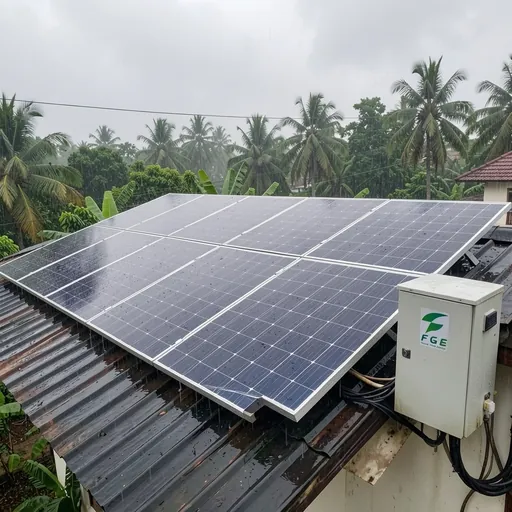
"We get so much rain — will solar even work here?" It's the most common question we hear from homeowners in Thrissur, Kozhikode, Kottayam, and the high-rainfall districts. The honest answer: yes, solar works in Kerala's monsoon — just at reduced output, which is fully expected and accounted for in any good system design.
Kerala gets 120–140 rainy days per year (June–September for the southwest monsoon, October–November for northeast). But here's what most people don't realise: solar panels don't need direct sunlight. They generate power from daylight — including diffused light on overcast days.
Key insight: Germany — which gets far less sun than Kerala and has far more overcast days — is one of the world's top 5 solar energy producers. Kerala's annual irradiation of 1,700–2,000 kWh/m² is excellent by global standards.
What Actually Happens on a Rainy Day in Kerala
Solar panel output on a cloudy or rainy day depends on how thick the cloud cover is:
| Sky Condition | Irradiance Level | Output (% of peak) |
|---|---|---|
| Clear sunny day | 900–1000 W/m² | 100% |
| Light cloud / haze | 600–800 W/m² | 60–80% |
| Overcast (thick cloud) | 200–400 W/m² | 20–40% |
| Heavy rain | 50–150 W/m² | 5–15% |
| Night / zero light | 0 W/m² | 0% |
Even on Kerala's gloomiest monsoon days, your panels are generating 10–40% of their rated capacity. That's not nothing — a 3 kW system generating 30% still produces about 3.6 units on a fully overcast day, enough to run fans, lights, a refrigerator, and a TV.
The Annual Generation Picture
Here's what a well-designed Kerala solar system actually generates across the year:
| Month | Avg. Peak Sun Hours | 3 kW System Output | Notes |
|---|---|---|---|
| January–February | 5.5–6.0 hrs | 450–500 units | Best months, clear skies |
| March–April | 5.0–5.5 hrs | 400–460 units | Pre-monsoon heat, some haze |
| May | 4.5–5.0 hrs | 360–420 units | Transition month |
| June–July | 2.5–3.5 hrs | 200–280 units | Peak southwest monsoon |
| August–September | 3.0–4.0 hrs | 240–340 units | Monsoon tapering off |
| October–November | 4.0–4.5 hrs | 320–380 units | Northeast monsoon |
| December | 5.0–5.5 hrs | 400–460 units | Clear winter skies |
Notice that even in June–July (worst months), you're generating 200–280 units — which for most homes covers a significant portion of consumption. And in the high-production months (Jan–May, Dec), you're often exporting surplus to the grid under KSEB net metering, building up credit that offsets your monsoon deficit.
How Net Metering Solves the Monsoon Problem
This is the key mechanism that makes solar financially viable year-round in Kerala. Under KSEB's net metering policy:
- In the sunny months (Jan–May, Nov–Dec), your system generates more than you consume. The surplus goes to the grid, and KSEB credits your account.
- In the monsoon months (June–Sept), your system may generate less than you consume. You draw from the grid, but the charges are offset by your accumulated credit.
- At the end of each billing cycle, you pay only the net amount. In many cases, the annual net is close to zero.
Real-world example: A home in Ernakulam with a 3 kW system exports 600+ units in March–April. That credit covers the deficit of 200–250 units in June–July. The annual net consumption from the grid can be near zero.
Common Monsoon Myths — Busted
"Solar panels stop working when it rains"
Rain actually cleans your panels, removing dust and bird droppings that cause micro-shading. A rain shower often improves output compared to dust-covered panels on a dry day. Panels are IP68-rated for water ingress and tested to withstand heavy monsoon conditions.
"You need batteries to make solar useful in Kerala"
Not necessarily. On-grid (grid-tied) systems with KSEB net metering are financially the most efficient solution for most Kerala homes. The grid acts as your "battery" — you bank surplus and draw it back later. Batteries add cost but make sense if you have frequent power cuts or want energy independence.
"Kerala is too cloudy for solar to be worth it"
Kerala receives 1,700–2,000 kWh/m² of annual solar irradiation. Germany manages with 1,000–1,100 kWh/m² and has 60+ GW of installed solar. The UK, Denmark, and the Netherlands all have thriving solar industries with far less sun than Kerala. Our monsoon months are offset by excellent irradiance October–May.
"Panels will blow off in storms"
Quality rooftop mounting systems are engineered for wind loads up to 150+ km/h — well above typical Kerala cyclone wind speeds at inland locations. Coastal installations require additional wind-load calculations, which any responsible installer will perform.
Should You Upsize Your System for Monsoon?
Yes — slightly. A standard rule for Kerala is to size your system to generate 110–120% of your annual consumption (not just a monthly average), to account for the monsoon deficit. This means:
- If your consumption is 350 units/month (4,200 units/year), size your system to generate 4,600–5,000 units/year.
- For most Kerala districts, this means a 3–3.5 kW system rather than a 2.5 kW system for 350 units/month.
- The additional cost is often within the PM Surya Ghar subsidy window, so there's little reason not to upsize within the 3 kW cap.
High-Rainfall Districts: Special Considerations
Wayanad, Idukki, Kozhikode, and Kannur see significantly more rainfall than southern districts. For these areas:
- System sizing: Add 15–20% generation buffer vs. southern Kerala.
- Panel selection: Choose panels with a low temperature coefficient (good for cooler highland climates in Wayanad/Idukki) and high low-light performance.
- Hybrid systems: If power cuts are frequent during storms, a hybrid system with battery storage makes more sense here than in Thiruvananthapuram or Ernakulam.
- Mounting: Ensure wind-load calculations are done for rooftop height and local wind patterns.
The Bottom Line
Kerala's monsoon is not a reason to avoid solar — it's a reason to design your system correctly. A properly sized on-grid system with KSEB net metering handles the annual variation smoothly, with sunny months building credit that offsets the monsoon dip. Thousands of Kerala homes have been running solar systems for 5–10 years and still get near-zero electricity bills year-round.
If power backup during storms matters to you, a hybrid system with a battery adds resilience. Our team will help you decide which configuration makes sense for your location, consumption pattern, and budget.
Want to know the right system size for your district and consumption?
Get a free assessment from our Kerala-specialist team.